
How did the Divine Feminine Become Inverted?
Table of Contents
- Mary Magdalene & Goddess Lineage
- Goddess Parallels and Womanhood
- Divine Feminine Suppression Across the Ages
- Contemporary Reclamation and the “Return” of the Suppressed Feminine
- How Is the Divine Feminine Left Out in Historical Terms?
- Esoteric, Fringe & Gnostic Interpretations
- The Suppression of the Divine Feminine in Voyagers II
- A Critique of Power from Fringe Narratives
- Why it Still Matters Today
When we look at history, there is a complex pattern of archetypes and historical context that distinguishes the symbology of the divine feminine: the systematic inversion, or exile, of feminine divinity from patriarchal religion. This essay approaches the suppression of the divine feminine as a layered, historical, archetypal, symbolic process shaped by changes of power, culture, and religious authority.
Within Christian tradition, Mary Magdalene is interpreted as a Jewish woman, the witness of the crucifixion, and the first to see the resurrection, both central and obscured, and stripped of theological reverence. Many feminist scholars focus entirely on her and the role she had in early Christianity, noting how her significance was narrowed within the canon while alternative traditions preserved a more complex story.
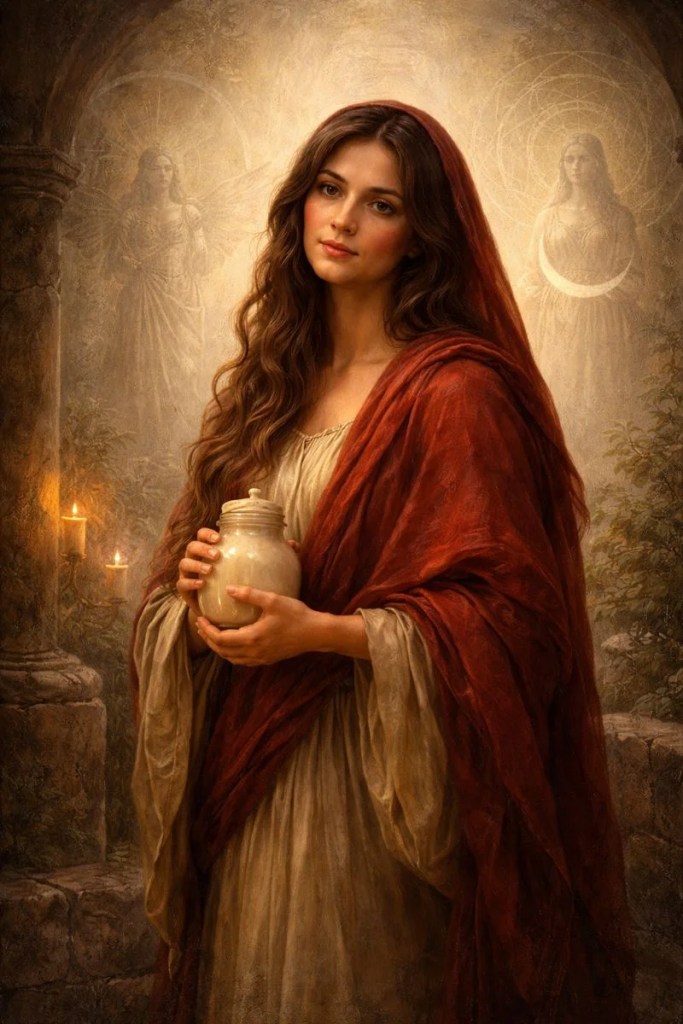
When compared to a broader cultural context, the goddess Isis and Mary draw a long, debatable comparison between the two, especially in the Madonna and child iconography. What’s interesting is, Isis is documented as being worshipped during Mary Magdalene’s lifetime. So parallel currents existed without direct association.
By examining Mary Magdalene alongside goddesses such as Inanna, Hathor, Aphrodite, and Sophia, this essay explores how the divine feminine was gradually transformed from cosmic source to symbolic meaning as patriarchal systems consolidated power. Drawing from academics, feminist theology, psychology, and symbolic esotericism, the analysis traces how feminine divinity was displaced, inverted, and preserved at the margins of spiritual consciousness.
Email / Newsletter
Receive reflective insights, research-informed context, and updates when they’re ready.
Mary Magdalene & Goddess Lineage
Comparison Between Goddesses
Religious scholars show comparable themes of feminine wisdom, presence, and resurrection life motifs across eastern cultures. Those in theology or feminist scholar groups explore how the Magdalene may have been suppressed or inverted in patriarchal religions. The imagery of Madonna and Child reflects patterns of Isis and Christian imagery without direct correlations. All threads relate to the cultural context of goddesses that were widely known when early Christians started to make a name for themselves. Peer-reviewed scholarships compare context and imagery, where symbolism in some Christian art echoes the motifs found in goddess traditions.
| Feminine Figure | Archetypal Role / Parallel |
| Aphrodite (Venus) | Embodiment of love, beauty, and erotic power—linked to Magdalene in goddess-oriented spirituality as sacred love or eros. (Sapiens) |
| Inanna/Ishtar | Sumerian/Babylonian goddess of love, war, and descent to the underworld—archetype of transformative feminine power. (OUP Academic) |
| Isis | Egyptian mother, mourner, and resurrector—a mythic pattern mirrored in Magdalene’s grief at the tomb. (serenbertrand.substack.com) |
| Hathor | Egyptian goddess of love and fertility, whose traits were syncretized with Isis and Aphrodite. (Wikipedia) |
| Shekhinah | In Kabbalah, the feminine divine presence is interpreted in some mystical Christian theology as analogous to Magdalene’s spiritual presence. (magoism.net) |
| Hindu Goddess Lineages | Esoteric interpretations equate figures like Shakti/Kali/Parvati with the “cosmic feminine” that overlaps conceptually with Sophia or Magdalene archetypes. (Wikipedia) |
Goddess Parallels and Womanhood
The global consensus of the goddess reflects the resilience, protective nature, and regenerative essence of womanhood. Female deities across civilizations have been spoken about for centuries, indicating a consistent theme of power, erotic autonomy, and emotional sovereignty, which are essential in humanity’s survival and spiritual upheavals.
In one article, the feminine cults were esteemed for responding to cycles of destruction and rebirth, termed the matrix of renewal, during periods of war and famine.
Inanna also shares a similar paradigm of transformation through crisis. Her descent into the underworld and being stripped of status and adornment symbolize feminine endurance and renewal through vulnerability. A.R. Ahmed’s study compares Inanna’s role as a deity of both love and war, worshipped as a source of courage and justice during national crises of Mesopotamia.
During this time of war, temples of Inanna become communal centers of lament and empowerment, especially for priestesses who embodied her role in ritualized mourning.
Aphrodite, with her stereotypical nature of sensual pleasures, also served as a sanctuary of social healing. C. Rahaim’s Not in God’s Image explains how temple rites of sacred sexuality acted as channels for reconciling the events of war and loss, re-establishing order through love and bodily restorations. She represented the return to harmony through the feminine principle of recognizing eros, death, chaos, and fertility.
The goddess Isis symbolized maternal endurance, as she mourned Osiris yet resurrected him. D. Leeming notes in Jealous Gods and Chosen People that Egyptian communities worshipped her during empirical disasters, seeking her “restoration of the lost body” in response to the fragmentation of destabilizing events.
In Jewish mysticism, Shekhinah represents God’s feminine indwelling, or anything that remains after all else fails. Her presence is contemplative in the spark of hope that accompanies Mary Magdalene in exile, showing the divine feminine as endurance itself.
Hindu goddesses like Shakti, Durga, Kali, and Parvati represent the primordial creative power that confronts crisis through direct transformative violence in times of invasion or plague. They are historically intensified, symbolizing cosmic rebalancing, as both destroyer and healer. P. Monaghan documents similar patterns across regions where women’s rituals of the goddess were acts of communal defiance and spiritual autonomy.
Throughout all traditions of the goddesses, the theme is undeniable: womanhood represents cyclic renewal. In these contexts of eastern mysticism, the divine feminine is responsive as she absorbs chaos and transforms it into restored order. The maternal, erotic, and creative archetypes reconnect the collective psyche that helps restore balance. And it is reflected that resilience through transformation is a sacred capacity to nurture, fight, mourn, and rebuild.

Join the Telegram for short reflections, updates on ongoing projects. From time to time, I will offer prompts for reflection or invite conversation around a shared question.
Divine Feminine Suppression Across the Ages
Archaeological and mythographic evidence suggests that early agrarian societies (7000-3000 BCE) centered their spirituality around female deities symbolizing fertility and renewal. S. Husain describes how figurines that were seated, voluptuous, and fertile embodied the creative totality of life, which reflects a worldview where women were subordinate to biology rather than cosmic law. J. Markale in The Great Goddess references the feminine as radically suppressed, as Indo-European and patriarchal warrior cultures expanded, shifting the feminine energy from maternal renewal to masculine transcendence.
The Patriarchal Turn: from Goddess to God
In R. Reuther’s seminal Goddesses and the Divine Feminine, she argues that political centralization, urbanization, and the rise of monotheism required a single male deity to justify the structure of patriarchal systems. The divine feminine was contained within limits where her womb was constricted as passive matter animated by masculine logos.
The feminine power was interpreted as emotional, dangerous, or redemptive only through masculine mediation. For instance, Inanna’s transformation into the subservient Ishtar, Isis’s reframing as the mother of Horus rather than the autonomous creatrix, and the Hebrew Skekhinah’s exile from the center of worship all show a pattern of inversion. According to Asher-Greve & Westenholz, in Goddesses in Context.
The suppression happened between 3000 BCE and 1000 CE across the eastern regions and later Europe. Each culture resulted in domesticating its goddesses as property, or penitents rather than cosmic equals.
The Inversion in Abrahamic Religions
Within Judaism and Christianity, the female goddess was reverted back to mystical and marginal currents where only small groups gathered for reverence. The Virgin Mary, Shekinah of Kabbalah, and Mary Magdalene in Gnostic texts were echoes of exiled goddesses, removed from ritual to symbolic periphery.
K. Young observes that female imagery was to be absorbed by the masculine divine body as an act of conquest for transcendence with maleness and immanence with subservient nature.
The Cultural Mechanics of Suppression
| Mechanism | Description | Example |
| Theological Reframing | The goddess transformed into a consort of a male god | Isis → “Seat of Osiris” |
| Mythic Inversion | The feminine portrayed as dangerous chaos subdued by male order | Tiamat slain by Marduk |
| Social Legislation | Restriction of priestesses and temple sexuality | Babylon & Israel, 2nd millennium BCE |
| Philosophical Rationalism | Matter/flesh coded as female and inferior | Greek dualism (Plato–Aristotle) |
| Colonial & Religious Expansion | Indigenous goddesses suppressed as “idols” | Hindu Shakti cults under British rule |
These dynamics reveal that suppression was a systemic takeover of the feminine principle from source to symbol.
C. Eller calls this theological inversion in her essay Divine Objectification. The goddess image remains, but her autonomy is stripped, used to sanctify passive femininity or erotic purity rather than divine sovereignty. Others frame this inversion as patriarchal religion externalizing the divine masculine and repressing the inner feminine to create cultural neuroses and ecological imbalance, as F. Perot frames in The Re-Emergence of the Divine Feminine.
Contemporary Reclamation and the “Return” of the Suppressed Feminine
Many spiritualist movements pertaining to goddess spirituality through Substack essays, feminist theology frames the suppression of the divine feminine as a wound in collective consciousness.
T. Nicolae notes that the resurgence of interest in Inanna, Isis, and Shakti is responding to centuries of “female exclusion and assault by patriarchal theology,” seeking to re-integrate the sacred erotic, intuitive, and dimensional aspects of being.
K.S. Coleman describes contemporary rituals and women’s circles as ethnographies of healing, where goddess archetypes become the act of undoing historical repression.
How Is the Divine Feminine Left Out in Historical Terms?
Mary Condren argues in Suffering into Truth: Constructing the Patriarchal Sacred that early theologians rewrote sacred history to exclude maternal symbolism, replacing the birth-giving cosmic matrix with divine word and transcendence. The “violent suppression of the maternal substrate” created a hierarchy in which only male mediation connected humans to God.
In Christa Christ’s article Heretics and Outsiders (1978), she explains how medieval Europe persecuted female mystics whose embodied spirituality threatened clerical control. The pattern of rebranding female spiritual authority as heresy.
Historical Mechanisms of Exclusion
| Mechanism | Historical Example | Effect |
| Theological Revision | Yahweh replaces Asherah; Zeus overthrows Gaia | The male creator displaces maternal cosmos |
| Philosophical Dualism | Plato and Aristotle separate mind (male) from matter (female) | Matter labeled inferior, passive |
| Clerical Monopoly | Priesthoods restricted to men | Women barred from sacral mediation |
| Colonial Religious Expansion | Christianization & Islamicization of goddess regions | Indigenous feminine symbols destroyed or syncretized |
The exclusion of women was hardened through institutional control, and women’s presence in leadership was branded as deviant.
Archetypal & Psychological Reasons of the Suppression
There are aspects to why patriarchal systems seek control over maternal appearance. One is the control of reproduction, where the independent goddess was framed as a threat.
Female deities were interpreted as unpredictable with nature, and male gods symbolized order, which indicated fear of chaos.
Western theology emphasized spirit over flesh; thus, the feminine became identified as other (flesh and earth to be overcome).
Oral goddess traditions were replaced by written scripture controlled by literate male elites to justify textual authority.
C. Eller’s Relativizing the Patriarchy (University of Chicago Press, 1991) describes this as a cultural feedback loop where men monopolized sacred interpretation, and patriarchy appeared mandated.
The Return of the Divine Feminine
In both the 19th and 21st centuries of feminist theology, scholars and mystics have re-symbolized the repressed feminine to heal and re-balance the gender archetypes. According to Judith Tobler’s Beyond a Patriarchal God, transcendence can be brought “back to the body” by reuniting divine and material principles.
Esoteric, Fringe & Gnostic Interpretations
(Take with a grain of salt; read what resonates and leave what doesn’t.)
In some esoteric spaces (if you know where to look), extraterrestrial control narratives often include claims that negative alien agendas are responsible for suppressing feminine frequencies in numerous ways. According to the “Ascension Glossary,” the true sophianic consciousness has been enslaved, inverted, or distorted so the female principle is turned against life itself, using violent religion, ritual abuse, and symbolic inversion to weaken the human connection to Sophia. This is not verifiable evidence.
Many conspiratorial writers claim negative ETs have replaced intuitive spirituality with blind faith in authoritarian religion as a tool of control. These are purportedly structured by creating divisions, dogma, and ignorance that keep higher feminine wisdom out of the picture.
What Does Sophia Represent in Gnostic Traditions?
A similar interpretation might appear in the Gnostic & Esoteric tradition, where Sophia falls into error and becomes trapped in the material world, her true light is hidden. Some fringe interpreters may overlay this with ET deception agendas. Also, David Icke draws similar analogies between the demiurge and archonic forces to frame suppression as an interdimensional deception.
You might see similar interpretations across Reddit, blogs, and metaphysical forms where channeled proclamations about Sophia as a sovereign creator are being hidden by cosmic deception or manipulation.
Law of Gender
The Ascension Glossary defines “Law of Gender” as cosmic balance between masculine and feminine forces. Where the Christos-Sophia is the hierogamic union of energetic wholeness. These interpretations mirror Hermetic and alchemical systems with energy metaphors and cosmology.
The suppression is interpreted in several key points that are worth noting.
Using the word “Christ” to justify division and control in war, dogma, and hierarchies, indicating violent religions. Energetic inversions of planetary grids to pervert sacred sexuality, creativity, and intuition. The social patriarchy of human cultures mirrors the energetic distortions through systems of misogyny and domination. The loss of direct gnosis of people seeking authority outside themselves rather than within. These show parallels to Gnostic themes of archonic deception, where cosmic parasites obscure divine wisdom.
The Suppression of the Divine Feminine in Voyagers II
In a similar current of Voyagers II, the suppression of the divine feminine is presented as deliberate, multi-layered intervention rather than an accidental social imbalance. During the second seeding, the Anunnaki introduced a “sexist slant” into the Law of One teachings to reframe women as subordinate and provide reproduction. The original Christo-Sophia balance, where masculine and feminine principles were inverted into patriarchal dominance, created a false hierarchy that severed humanity from cooperating through cosmic balance.
It is also said that distortion through institutional and religious structures deepened after the fall of Atlantis. Where elite Templar-Annu factions turned spiritual knowledge into rigid dogma, persecuting those who sought direct inner knowing. In doing so, they embezzled unity with dualism and control, reinforcing male authority while marginalizing the intuitive and compassionate qualities associated with the feminine principle. These reflect the negative alien agendas that include technological manipulations.
The suppression is also framed as a planetary crisis encoded into human DNA and consciousness. Genetic distortions such as Zeta Seals are described as blocking the heart center within the human template. Yet the text also emphasizes restoration of the masculine and feminine currents through the Christos-Sophia code. Reclaiming the divine feminine has more to do with social or spiritual healing, but a rebuilding of humanity’s original design that is rooted in balance, compassion, and direct connection to Source.
Consistent Points of Fringe Narratives
Deception:
Many narratives portray hidden intelligence feeding off of fear and misinformation, which keeps humanity disconnected from its true nature (often equated with Sophia/divine feminine).
Control:
Alien control narratives may serve as a way to introduce the idea through metaphor for psychological, spiritual, or societal suppression, and such narratives are used to explain why people feel blocked from accessing intuitive or feminine wisdom.
With Voyagers II, there is a symbolic pattern of feminine suppression in the text.
| Archetype | Suppressive Agent | Method | Outcome |
| Sophia / Christos-Sophia | Anunnaki & Templar-Annu | Religious distortion & sexual domination | Hierarchical control, loss of gnosis |
| Divine Feminine Energy | Elohim factions | Genetic eugenics through male dominance | “Chosen lineages” & limited ascension |
| Human Intuition / Heart Chakra | Zeta groups | DNA seals & frequency manipulation | Suppression of emotional intelligence |
| Planetary Sophia (Tara/Gaia | Extraterrestrial warfare & grid interference | Energetic fragmentation of the planet | Reversal of Christos Blueprint |
The suppression is presented as a multidimensional colonization consisting of biological (DNA distortion), psychological (religious and gender control), energetic (frequency and morphogenetic manipulation), and cosmic (Sophia/Tara’s fragmentation) aspects.
It is perhaps that womanhood is not just the feminine but the creative, intuitive aspect of Source that is inverted and enslaved by power hierarchies in both human and non-human. Restoring the Christos-Sophia code happens through reclaiming the unity of gender, soul, and cosmic intelligence.
Perspective Synthesis
When taken symbolically, the “divine feminine suppression” narratives speak to a deep archetypal wound in human consciousness. In Jungian and psychological terms, these stories externalize an inner process of disconnection from wholeness. When one dominates, the psyche loses equilibrium; drawing from stories like Sophia’s fall dramatizes the return of the repressed. These may serve as maps of psychological reintegration where intuition and connection have been marginalized, but the psyche keeps demanding to reawaken.
A Critique of Power from Fringe Narratives
These narratives may also express resistance to hierarchical religion and technocratic culture from an anthropological and theological perspective. Historical patterns show that institutional religions centralized male intermediaries between humanity and divinity, and scientific rationalism often equated progress with domination of nature. The cosmic stories of feminine consciousness being suppressed by alien forces give voice to a spiritual critique of the patriarchy of materialism.
Academic Context
Scholars have documented how monotheistic systems replaced goddess cosmologies with male deities, indicating a cultural evolution reflecting shifts in power and production.
When we talk about esotericism, both Voyagers II and Ascension Glossary represent Gnostic revival movements combining esoteric Christianity, theosophical cosmology, and ufology. According to scholars like Christopher Partridge and Wouter Hanegraaff, these myths are “re-enchantments of modernity,” where many are disenchanted by science, offering meaning in cosmic terms.
Why It Still Matters Today
2026 is the age where renewed interest in goddess spirituality and the divine feminine reflects a global search for balance, sustainability, and wholeness. Even the most fringe narratives serve a symbolic healing function: they invite a bridge between science and spirituality. Redefining sacredness in embodiment and empowering marginalized voices through cosmic allegory. They matter because they are all felt through humanity’s imbalance between dominance and empathy, intellect and wisdom, and light and matter.
Whether approached academically, psychologically, or symbolically, the suppression of the divine remains relevant because it mirrors humanity’s unresolved relationship with power itself. To reclaim the feminine is not to replace one dominance over another, but to remember a forgotten dimension where creation, compassion, and wisdom arise through integration.
This essay does not assert a single truth, nor does it ask for belief. It offers a framework for reflection where I invite historical narratives, symbols, and cultural structures to shape our understanding of the sacred and the feminine within us all.
In My Perspective
Aside from being a reflective platform, I consider all perspectives until proven otherwise. This material is not meant as literal truth but to give you an idea, and reflect upon what I’ve given you to arrive at your own interpretations for better clarity and understanding. I do my best to write about these topics from a grounded standpoint and analyze which narratives have consistency and how they can apply to our understanding of different interpretations.
This work is offered as an interpretative synthesis rather than a definitive claim, inviting readers to engage critically and reflectively.


“AI tools were used for research synthesis and editorial assistance; all final texts are reviewed, rewritten, and approved by the author.”
References
https://docs.google.com/document/d/1nC8MjuGledybVoSoOnNCVYCgbEVRGJp7-oQ7am01XYE/edit?usp=sharing
Copyright 2025 Trent Phillis, http://www.TrentPhillis.com, All Rights Reserved. Please copy and share this article as long as it is shared in its entirety, including this copyright notice, and the information is not altered, excerpted, or added to; credit of authorship and my website address (www.TrentPhillis.com) is included; and no money is exchanged. For any other uses, please contact Trent Phillis to obtain permission. Thank you.


 Yeshua and Mary Speak
Leave a comment