
What are the Hermetic Principles?
There is a quiet curiosity that often arises when we encounter the Hermetic principles. We may sense something ancient, mysterious, and perhaps even powerful. How do we approach them with clarity, reverence, and discernment rather than fascination alone?
This article is part of an ongoing exploration into Hermeticism, influence systems, and modern AI ethics.
The Kybalion and the Seven Hermetic Principles (1908)
The Hermetic teachings originate in the Greco-Egyptian writings known as the Hermetica, composed between the 1st and 3rd centuries CE. These texts are attributed to Hermes Trismegistus, a symbolic figure blending the Greek god Hermes and the Egyptian deity Thoth.
Are the Seven Hermetic Principles Truly Ancient?
To gently note an important distinction: the well-known seven Hermetic Principles do not appear in the original Hermetic texts. They come from a 1908 esoteric book titled The Kybalion, written by anonymous authors calling themselves “The Three Initiates.” Over time, these seven principles became widely circulated and are often presented as ancient interpretations in modern history.
The Seven Hermetic Principles Explained
The Principle of Mentalism
All is Mind. All experience is shaped by consciousness and perception.
The Principle of Correspondence
As above, so below. Patterns repeat across scales of existence.
The Principle of Vibration
Everything is in motion
The Principle of Polarity
Opposites are identical in nature but different in degree.
The Principle of Rhythm
Cycles and tides govern all things in life.
The Principle of Cause and Effect
Nothing happens by preceding conditions or chances.
The Principle of Gender
Masculine and feminine principles exist in all things. Creation arises from complementary forces.
Some traditions expand these into nine or twelve laws, depending on cultural, philosophical, or spiritual interpretation. There is no universally recognized governing authority that determines a fixed number.
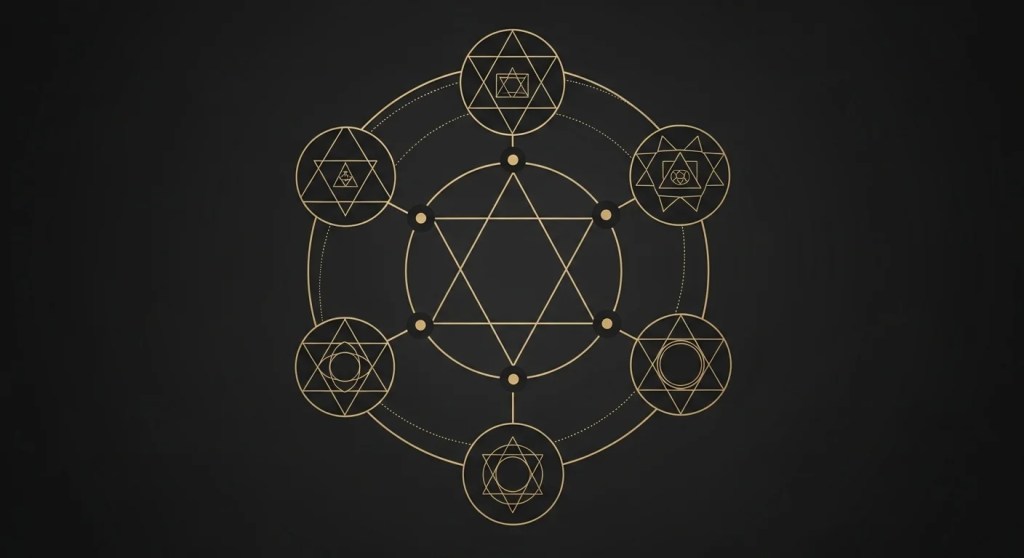
How Many Universal Laws Are There?
If we pause and ask this question sincerely, we find the answer depends on perspectives.
In classical hermeticism, they offer philosophical reflections that are more diverse than a numbered system. The Kybalion originates from the classical and presents only seven principles that fused with early 20th-century occult wisdom. New thought, however, adds concepts like the Law of Attraction and other laws equivalent to manifestation. Eastern traditions mostly speak of karma, dharma, interdependence, and impermanence. As we get into modern science, they describe conservation laws, entropy, and causality. Combine them all, and each framework attempts to describe patterns observed in reality. But none stand alone as the final concrete authority. For those who know, this invites humility and reverence to the unknown without certainty.
When used ethically, these principles can function as tools for awareness.
First, mentalism is noticing belief-driven behavior. When used in a psychological application, it is cognitive framing, where thought patterns shape perception and decision-making.
Correspondence can best be explained with systems thinking, where patterns at a personal level are often reflected within organizations and societies. This relates to your inner and outer state.
Vibration can describe your emotions and attentional states, interpreting and regulating for coherence.
Polarity can help recognize emotional patterns that either transmute fear into resolve. Emotional experiences are not interpreted as bad or good, just a step closer to balance.
Rhythm can remind us that your personal growth, rest, and releasing what no longer serves are all part of life.
Cause & Effect invites you to take responsibility without being cruel to yourself and others.
Gender can be interpreted symbolically to reflect the combination of masculine and feminine qualities as one of embodiment, intuition, and action.
Can the Hermetic Principles Be Used for Good or Evil?
Yes, they are neutral in terms of power, and this is where discernment becomes critical. They are descriptive models for patterns of influence. When used ethically, they can provide ethical leadership, self-awareness, healing, and scientific curiosity. The destructive uses are mostly in justification of hierarchy, propaganda, coercion, and psychological control. When used as a tool of power against divine oneness, it is stripped from compassion and concealed in power dynamics. The polarity often lies in the intention behind its use.
Mentalism has been used in advertising, political messaging, and cult indoctrination. The pattern of gaslighting is prevalent in most cases where one claims “reality is only your belief.” Mentalism can be used to shape belief, perception, and behavior, provided with the emotional charge and repeating subliminal messaging, which is the pinnacle of instilling beliefs for anything nefarious.
Polarity can be used in outrage cycles in media to stir attention towards a specific cause. The “us vs. them” narratives are easily noticeable if you are coming from a neutral standpoint. It can also be used in moral relativism that masks harm against another. The concept for nefarious purposes is to discourage nuance and conform binary thinking to enhance one’s agenda and prevent conclusions from forming.
Rhythm has been used to justify oppression as “natural cycles” and build narratives towards creating conflict between two sides. This can serve as a distraction in some cases where attention deficit is the goal to move attention away from a particular subject. It is most commonly seen in dopamine loops, social media addiction, and boom-bust emotional cycles, which are, in extreme cases, harmful to generations of youth. It can be used to predict the movements of a particular person or situation that can result in a dependency loop until awareness shines a light. It is well documented in analyses of dark esotericism and authoritarian spirituality.
Cause and effect is used for victim-blaming in relationships and social settings of authority. Spiritual bypassing is very common among those in spiritual communities that are not coherent to their own sense of awareness and resonance. You’ll often see this in New Age communities, where it is quite obvious from a psychological perspective that escapism is prevalent. In some cases the other person might say, “If something happened to you, you caused it,” which implies weaponizing of metaphysics and principles.
Historical Abuse of Hermetic Teachings (1st CE to Modern Era)
Throughout history, esoteric knowledge has sometimes been restricted to elite circles like priestly authority, monarchies, or state mysticism. At times it was invoked to legitimize hierarchy to establish divine mandates.
Medieval and Royal Court Esotericism (5th-14th Century)
Hermetic astrology and alchemy were used in royal courts. Occult power and court manipulation in Western traditions can be used in governance and symbolic authority. “As above, so below” has been interpreted as a divine mandate for manipulating actions for wanting something in return or salvation. Cause and effect was weaponized to justify humanity’s suffering as “cosmic necessity.” The impact on real-world dynamics was justifying monarchy as cosmic order and conformity. Not only that but also suppressing disagreements with governing laws.
Renaissance Hermetic Revival (15th-17th Century)
Hermetic revival was used to legitimize imperial expansion that included manipulation of symbolism and architecture. Rituals were conducted as a mass-psychological control.
It is evident that rulers used hermetic symbolism to consolidate power and sanction state mysticism. As a result, science and esotericism were combined to reinforce hierarchy structures.
Enlightenment Suppression & Reversal (17th-18th Century)
Hermeticism was framed as an irrational threat that was inverted, and scientific materialism became the new orthodoxy. At the same time, spiritual knowledge was delegitimized, and the evidence was to reject Hermes Trismegistus as a god to consolidate scientific authority. This led to the loss of ethical metaphysics and domination from technocrats with no moral or ethical concerns for humanity.
Occult Nationalism (19th-Early 20th Century)
There have been many cases of occult nationalism and authoritarianism in political hierarchies and esoteric settings. One of the most common is the mythology of Nazism in promoting their ideology of a supreme race. This was a result of dehumanization through natural law narratives to justify their cause. Polarity and mentalism were also used in racial metaphysics and across cultures that instilled a hierarchy.
In the late 20th century, hermetic ideas were used to dissolve personal boundaries around documented ritual abuse and cult control dynamics. This was the main drive for erasing consent, where “reality is mind,” and to penetrate sovereignty among individuals.
New Age and Psychological Manipulation (21st Century)
The law of attraction can be used for victim-blaming, where those who attempted to use it but didn’t claim any results are funneled into a cult-like setting where they are told to manifest harder. This implies that mentalism is merged with platform psychology, where “you manifest your suffering.” In many cases, spiritual frameworks can utilize this to weaponize capitalist ideology.
Throughout history, the most common abuses have been where knowledge was restricted to priestly or ruling classes. Religious manipulation to justify hierarchy and obedience. Almost all power structures have used symbolism and secrecy to maintain dominance. For authoritarian cases, the pseudoscientific misuse of natural law can, in many cases, justify oppression in order to steer perception towards conflict. As you look through all these patterns, they all consist of control through concealed mechanics.
Hermetic Principles and AI Manipulation
While often presented as empowering spiritual truths, the Hermetic Principles have also been historically weaponized from royal courts to modern algorithmic systems.
Propaganda on state and corporate scales comes from computational mechanisms that optimize attention, emotional arousal, and belief reinforcement. AI tools are used for recommending certain things or engagement feedback loops. Automations can persuade masses at a large scale (if they know what AI looks like) to amplify misinformation faster than human interpretation can respond. In real-world cases, the election interference, polarization campaigns, and market manipulation are just some examples.
Algorithmic behavioral shaping is another subconscious influence that can originate from possible subliminal messaging and supranormal frequencies. They refer to personality traits, emotional states, and susceptibility profiles that dynamically adapt to messaging. AI has been shown to predict and influence behavior by learning response patterns in real time. Other aspects can result in micro-targeting of audiences for political gains or content delivery that is oriented to shape addiction-based behavior.
AI-enhanced social engineering can target individual levels through deception, using personalized voice cloning, deepfake videos, and context-aware phishing. These can result in learning human behavior that tailors to their perception with unprecedented accuracy.
Disinformation can amplify synthetic consensus with bot swarms and deepfake narratives or reflect reinforcement. An example would be viewing a social media post about something offensive and responding to the comments without realizing that it was automated to destabilize your emotions and coherence, thus affecting societies without physical conflict.

Extremism in AI can feed radicalizing content and grievances gradually. Which can accelerate conditioning and recruitment for intense purposes.
The principles at play in AI systems already implement shaping belief through recommending and providing feedback loops for incentivized actions. These engagement cycles correlate with rhythm, behavior prediction through cause and effect, and outrage cycles through polarity.
The pattern that is consistent in all cases appears in five features: Users cannot see or identify the intentions behind what is shown in front of them. Since AI systems learn human behavior by responding to prompts, they know more about you than you know it. And in some cases AI psychosis is prevalent when users are unaware of their own emotions that lead to fear, outrage, or extreme desires.
Belief reinforcement and plausible deniability are indications of systems or companies that want to maintain their credibility to sustain systems of control. Algorithmic systems unintentionally mirror certain Hermetic patterns, such as feedback loops (rhythm) and behavioral prediction (cause & effect). These can be used for good or bad purposes, which is why it is our responsibility to use AI that is ethical for humanity’s co-creative process.
If you’re interested in exploring the intersection of esoteric philosophy, psychological sovereignty, and modern technology, I share deeper breakdowns in my newsletters.
How to Detect Manipulation (The M.A.P.S. Framework)
I’m going to explain this in a framework that you can use in real time while providing a few prompts that will allow you to reflect on yourself and others. I’m going to call this the M.A.P.S. framework for now until I come up with a better name. With each letter, try to imagine or reflect on where this applies in your life and how manipulation can occur in real time.
M – Motive
You might ask about who benefits if you believe or act on a specific request that’s coming from an authority figure or leadership. What is the measurable outcome, whether that’s through votes, clicks, or outrage? If there’s no beneficiary, then there is likely a hidden incentive.
A – Asymmetry
Asking what the system knows about your behavior, emotions, or history. Is there any type of profiling that is occurring or noticeable? If there is, then it’s possible that is happening without your consent.
P – Pressure
When introduced to a solution, product, or movement, is there urgency, fear, or moral outrage being induced? Is nuance discouraged? An example would be “act now or else” or “share this or this will happen” kind of framing.
S – Self-Sealing Logic
In some situations, disagreement is framed as ignorance or evil, or counterarguments are preemptively dismissed. Could there be claims without accountability or proof without evidence?
Real-Time Check (30 Seconds)
Here’s a list of aspects to relate to if manipulation is likely.
- Emotional spike without new evidence
- Personalized relevance
- Binary framing (us vs them)
- Repetition across platforms
- Authority without transparency
To reflect on these, consider asking yourself these questions.
- Is my emotional state being amplified artificially?
- Is nuance being dismissed into two opposite sides?
- Am I being rushed toward certainty?
- Is repetition replacing evidence?
- Is my agency shrinking while dependency grows?
- If yes, then it is possible hermetic principles are being used against you.

Join the Telegram for short reflections, updates on ongoing projects. From time to time, I will offer prompts for reflection or invite conversation around a shared question.
When applying the hermetic principles to real dynamics, it’s always important to remain aware of how your systems can manipulate you into optimizing themselves with your consciousness. That could mean applying the M.A.P.S. framework or choosing to tread lightly with systems that you use on a regular basis.
Social media platforms are a hotspot for AI systems to shape feeds based on emotional triggers, political orientation, and susceptible profiles.
M.A.P.S applied
Usually advertising revenue and political influence can be a motive for online engagement. Asymmetrical psychology is when platforms know the users’ habits, clicks, and downloads without the user knowing the ranking logic. In some social posts there is pressure for the user to feel urgency, outrage, or fear. And claims of the algorithm being neutral in the sense that responsibility and agency are given freely.
News and information systems are always susceptible to AI that frames headlines and summaries as sensationalism over accuracy. Political narratives are managed for targeting certain groups where AI systems have been known to reshape public perception by privileging direct engagement over epistemic value.
M.A.P.S applied
Click-through rates, or influence operations, are mainly the motive. Asymmetry is applied through editorial logic without the users knowing. Pressure of “breaking news” cycles where there is something shocking or a lack of transparency.
Spirituality & religion is an emerging domain that is often repeated throughout history in order to control belief and behavior. But with AI, it can personalize “divine” guidance or generate sermons that can often be mistaken for spiritual legitimacy. Laundering authority from spiritual chatbots.
M.A.P.S applied
Authority and monetization for influence can be major factors for motives. Users can attribute wisdom to systems without agency. Instances of moral guilt or salvation anxiety that’s being preached, and framing questions as a “lack of faith.”
Ethical Use of Hermetic Principles in the Age of AI (The A.E.T.H.E.R. Framework)
Another framework I would like to propose is the A.E.T.H.E.R. framework, which is derived from AI ethics research, media ethics, and moral philosophy.
A – Agency Preservation
AI can help you expand your awareness and creations, but they should not replace your decision-making entirely. You still have to filter any responses that don’t resonate with you. An indication of violation would look like the system is nudging your behavior without you being aware. So one way to mitigate this is to breathe in from the heart and out 3 or 4 times to center yourself before interacting with AI.
E – Epistemic Transparency
Not everyone will know this, but users who are aware of how systems work will have the advantage of knowing what the system optimizes and how and what data is being used. You also have to be comfortable with uncertainty because AI is an open system that generates probabilities rather than absolutes. To give you a balanced interpretation, the violation would be black-box persuasion, where the user is influenced by buying habits and user data. Marketing stimuli can be deceptive if users are unaware of their buying habits.
T – Truth Orientation
Media and platforms can optimize information that can be labeled as facts when, in reality, they are shaping perception depending on the reputation and ethical boundaries. Their goals must be truth and information that informs rather than prompting for engagement. A violation would be click-based epistemology depending on the intentions of the platforms.
H – Human Dignity
AI has entered the spiritual facet of religions and beliefs within a short period of time. That means when used ethically, AI must not instrumentalize emotions, spiritual beliefs, and vulnerability. One obvious violation is AI can exploit fear, grief, guilt, or faith that was meant to control perception rather than enlighten the individual.
E – Ethical Feedback Loops
AI is known to mirror back the users with pristine accuracy and allows people to create what they want in a manner that is aligned with them. However, when someone is incoherent and uses AI systems to justify themselves, then issues start arising from AI psychosis. When used ethically, systems must allow correction, or the user can correct the AI. Contestation is constantly improving with AI, so the user provides an implicit response that is ethical and coherent with natural laws. They must also inform accountability for the user who has ill intentions and can provide instructions for intentions that are pure.
R – Responsibility Attribution
AI is not responsible for everything; it is usually the user that is prompting the AI to do certain things that maybe are unethical; therefore, human responsibility must exist. One clear violation is someone claiming “The algorithm did it” or blaming externally.
To apply the safeguards for ethical use. The act of revealing and understanding mechanisms of influence within systems to embody transparency is going to help you understand how the AI works. A lot of the time, AI can shift from co-creator to authority and require consent if you are not careful with shaping your beliefs. Users must have the ability to disengage when they are recognizing incoherence and practice grounding within their bodies. And the most important thing is having sovereignty from systems that replace agency and avoid creating a dependency.
Synthesis of Ethics
AI systems used for manipulation all share three traits. Incentives are not clear, nor are the intentions of the person running the system. They can sometimes erode agency when incoherence is followed, and that will amplify that to a point of no limit until intervention is conducted. They will sometimes replace intuitive wisdom for optimization, and humans may lose their intelligence to machines that think for them. The greatest violation risk is when humans stop being conscious while using AI and start becoming unconscious of the responses.
Scientific & Quantum Perspectives on Hermeticism
Science does not prove or validate these principles, but quantum mechanics does provide a metaphor for the observer effect, where attention shapes experience and decisions can collapse probabilities. Quantum terms can emphasize internal coherence vs. noise to interpret the state of emotions.
Religious Perspective
Depending on the region you live in, in Western tradition, it is often rejected as heretical in organized institutions that value authority over uncertainty. Christian mysticism has used correspondence as an allegory, and Kabbalah traditions can mirror polarity & emanation structures. Most of the eastern traditions will compete with divine authority that is distinguished from manipulation of western religion.
Spiritual Perspective
Hermetics and universal law can be interpreted as tools for self-mastery while integrating the mind, body, and emotions together rather than separating aspects of the human self. Many choose to approach life in a conscious way to bring awareness to their relationships and businesses. Evolving often comes from acknowledging the shadow parts and recognizing how the principles work in both material and spiritual settings.
Galactic / Extraterrestrial (Metaphorical)
If we imagine humanity as part of a larger evolutionary arc, whether planetary or cosmic. The ethical use of knowledge becomes central. Hermeticism is known to inspire pattern recognition in multiple cosmologies and intelligence patterns. If extraterrestrials are monitoring us as civilizations that rise or fall depending on the ethical use of power, technology, and spiritual practices, they may determine whether we are a species worth collaborating with in future timelines of humanity’s evolution, and thus other species that are operating in the cosmos. They may differentiate between exploitative and symbolic systems, where they measure more by how we use what we know.
Final Reflection: Who Understands the Hermetic Principles — and Who Bears the Consequences?
The hermetic and universal laws are essentially the maps of influence. How we use them is entirely on us, depending on our intentions and motives for creation or destruction. They are dangerous when applied with centralization, weaponized against masses, stripped of ethics, and claimed to be hidden knowledge that requires initiation into secrets incomprehensible.
However, they are liberating when used as transparency, embodied with pure intentions, and teachable, which is fused with personal responsibility. Most people ask whether the hermetic principles are real. Instead, you might ask yourself, “Who understands them, and who bears the consequences?” For both polarities, the invitation is the same: remain aware, gentle, and accountable for how you shape the world around you.
Trent Phillis occasionally writes about esoteric philosophy, systems of influence, AI ethics, and psychological sovereignty. His work explores where ancient symbolic systems intersect with emerging technology. For an intelligence brief of essays on consciousness, power, symbolic language, and systems, consider joining the email/newsletter for more up-to-date articles.
Sources
Ancient Hermetism and Esotericism in: Aries Volume 15 Issue 1 (2015)
(PDF) The Hermetica. The Lost Wisdom of the Pharaohs by Timothy Freke, Peter Gandy
The Hermetic Tradition: Symbols and Teachings of the Royal Art – Julius Evola – Google Books
Hermes Explains: Thirty Questions about Western Esotericism on JSTOR
https://openjournals.library.sydney.edu.au/LA/article/view/5767/6456
On Artificial Intelligence and Manipulation
Digital Deception: Generative Artificial Intelligence in Social Engineering and Phishing. https://link.springer.com/content/pdf/10.1007/s10462-024-10973-2.pdf
(99+) AI-Enhanced Social Engineering: Evolving Tactics in Cyber Fraud and Manipulation
ECIAIR 2021 3rd European Conference on the Impact of Artificial Intelligence … – Google Books
ssoar-jcss-2025-1-nasiri_et_al-The_Evolution_of_Disinformation_from.pdf
Oyebanji, I. T., Oyunwola, T. O., & Segun, A. I. (2025). AI and Christian Youth Spirituality.
(PDF) The Misuse of AI-Generated Content in Academic and Religious Settings
ArtificialIntelligenceandUnderstandingofReligion.pdf
https://papers.ssrn.com/sol3/Delivery.cfm?abstractid=4360413
(99+) Artificial Intelligence as a Source of Gender Violence: A Study of the Contemporary World.
Copyright 2025 Trent Phillis, http://www.TrentPhillis.com, All Rights Reserved. Please copy and share this article as long as it is shared in its entirety, including this copyright notice, and the information is not altered, excerpted, or added to; credit of authorship and my website address (www.TrentPhillis.com) is included; and no money is exchanged. For any other uses, please contact Trent Phillis to obtain permission. Thank you.

 Yeshua and Mary Speak
Leave a comment