
An Exploration of Heresy across History, Psychology, Spirituality, and Consciousness
Heresy once meant choice, not condemnation.
Before it became a crime, the word described a way of thinking, an independent selection among ideas. Over time, heresy transformed into a tool of authority, used to police belief, suppress dissent, and enforce social order. This article explores heresy across academic, psychological, spiritual, scientific, and even cosmic perspectives, revealing how what is condemned in one era often becomes the seed of awakening in another.
What Does “Heresy” Really Mean?
The word “heresy” did not begin as an accusation; it began as a choice. The Greek word, hairesis, simply meant “selection,” “choice,” or “school of thought.” In classical usage, it was neutral, describing philosophical lineages like the Stoics or Epicureans. Heresy is not defiance but a way of thinking that expands your ability to innovate.
This meaning shifted in the first and second centuries CE. Early Christian communities, seeking cohesion, recast the term. Choosing differently gradually became “choosing wrongly.” By the time church authorities codified their doctrine, heresy signaled deliberate departure from sanctioned belief. The word’s change reflected the consolidation of authority instead of the clarification of truth.
As Christianity institutionalized, belief became political and administrative. Irenaeus of Lyon cataloged divergent teachings to define orthodoxy, a method that became standard. Church councils formalized doctrine, linking right belief to authority. Imperial decrees, like the Edict of Thessalonica (380 CE), aligned doctrinal conformity with civil obedience. Heresy became punishable and marked boundaries more than ideas.
Heresiology emerged as the formal study of deviation. Early Christian heresiologists framed alternative teachings as dangerous, while Islamic scholars like al-Shahrastani surveyed sects descriptively. Across cultures, heresy reflects how difference is managed.
Modern scholarship broadens this lens. Sociologists like Zito (1983) and political theorists like Shogimen note heresy signals resistance to dominant norms, enforcing social boundaries. Even in science, ideas once deemed heretical, like heliocentrism, germ theory, and quantum mechanics, were disruptive. Heresy, in this sense, often precedes broader understanding.
Email / Newsletter
Receive reflective insights, research-informed context, and updates when they’re ready.
When Choice Became a Crime: How Heresy Turned Political
The fourth century marked a decisive shift. Christianity entwined with Roman state power, transforming belief into political loyalty. Under Constantine and Theodosius I, heresy was criminalized, and deviation became a threat to social stability and imperial cohesion (Barnard, 1995). Punishments escalated from exile to confiscation and eventually execution.
Augustine of Hippo reframed coercion as care. In his conflict with the Donatists, he interpreted “compel them to come in” as permission to enforce belief to save souls. Violence became medicinal, not punitive (Ryan, 1944). Resistance became moral corruption, and harm was recast as mercy.
By late antiquity, heresy was framed as ontological danger. Christian writers likened heresy to disease, poison, or corruption that threatened communities and cosmic order (Gaddis, 2005). This logic made violence appear preventative and necessary.
The medieval Inquisition institutionalized this logic. Heresy became a crime of identity, not just belief. Confession, torture, and execution were framed as moral and judicial duties. The Church claimed jurisdiction over truth, while secular authorities carried out punishment (McManus, 2020). Spiritual power translated into physical force without direct responsibility.
The Mechanics of Heresy Violence
Violence followed a pattern:
- Heresy is termed as contagion: ideas spread like disease and threaten society.
- Soul over body: Physical punishment was framed as saving eternal souls.
- Authority monopolizes truth: Dissent became sinful, prideful, or evil.
Those most targeted emphasized direct access to God, inner revelation, conscience over obedience, or independent interpretation. Accusations silenced dissent, simplified moral complexity, and protected institutional authority.
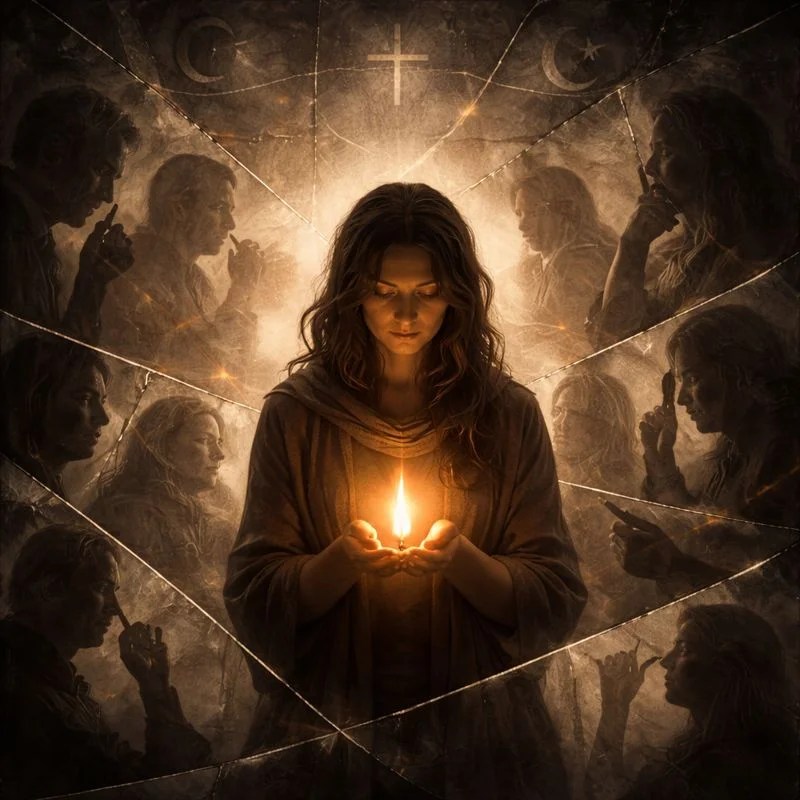
The Psychology of Heresy: Why Societies Punish Dissent
From a psychological perspective, heresy has nothing to do with moral failure but with how groups respond when shared beliefs are threatened. Heresy taps into deep-seated psychological vulnerabilities such as threats to self-esteem, anxiety about the unknown, existential fears, loyalty to one’s group, and worries about social upheaval. Challenging shared beliefs destabilizes consensus reality, prompting groups to attack perceived threats. Heresy is frequently a collective defense mechanism and not a moral issue.
Heretics, carrying the projected shadow of the group and confronting suppressed fears. They are punished not for differences in beliefs, but for forcing others to confront uncertainty. When the ego is confronted, scapegoating temporarily restores order to social conformity.
Western vs Eastern Views of Heresy
Western Religious Pattern
In Western Christianity, truth is singular and revealed through intermediaries. Heresy became willful rebellion, blameworthy, and an easy target for those who didn’t conform. In terms of truth, church authority and political order merged, making deviation a threat to society itself. Persecution was structurally enforced where singular truth cannot coexist with dissent (Barnard, 1995).
Eastern Religious Pattern
Eastern traditions prioritize correct practice over rigid belief. Error is considered ignorance, corrected through instruction or experience. Authority is pedagogical rather than coercive, reducing the moral justification for punishing belief. Some violence occurred, but it was either social or political, rarely funneled into a systematic doctrine (Peters, 1980).
Key Nuance
Eastern traditions were not always peaceful, and Western traditions were uniquely enforcing conformity. The difference lies in how belief is treated: singular and enforceable in the West, and developmental and instructional in the East.
Heresy as Spiritual Awakening
Heresy can mark awakening. Spiritual heretics trust inner revelation over dogma, perceive the divine directly, and evolve beyond inherited frameworks. Figures like Meister Eckhart, Rumi, the Cathars, and the Desert Fathers were labeled heretical because they bypassed institutional mediation (Ames, 2009). Heresy is not deviation; it is emergence, the courage to think, feel, and know for oneself.

Join the Telegram for short reflections, updates on ongoing projects. From time to time, I will offer prompts for reflection or invite conversation around a shared question.
Historical examples of those Accused of Heresy or Ridiculed
Spiritual Figures
Meister Eckhart (1260–1328)
- German mystic and Dominican theologian.
- Accused of heresy by the Church, some of his writings were condemned posthumously.
- His ideas about direct union with God challenged institutional authority.
Hypatia (c. 360–415 CE)
- Neoplatonist philosopher and mathematician in Alexandria.
- Murdered by a Christian mob amid political and religious tensions; accused of paganism and influencing civic unrest.
Joan of Arc (1412–1431)
- French visionary claiming direct divine guidance.
- Tried for heresy and witchcraft; burned at the stake by the English-backed Church court.
- Her insistence on personal divine inspiration threatened both religious and political authority.
Rumi (1207–1273)
- Persian poet and Sufi mystic.
- Some contemporaries viewed his ecstatic poetry and unconventional teachings as unorthodox.
- Criticized but largely tolerated; influence spread posthumously.
The Cathars (12th–14th c.)
- Dualist Christian sect in southern France.
- Targeted in the Albigensian Crusade, many were executed, often by burning at the stake, and accused of denying orthodox teachings.
The Gnostics (1st–4th c. CE)
- Early Christian sects emphasized inner knowledge (gnosis) over institutionalized belief.
- Declared heretical by early Church authorities; writings destroyed, members excommunicated or persecuted.
Teresa of Ávila (1515–1582)
- Spanish mystic and reformer of the Carmelite order.
- Placed under investigation by the Inquisition for mystical visions and unorthodox practices; ultimately recognized as orthodox and canonized.
Scientific Figures
Nikola Tesla (1856–1943)
- Inventor and electrical engineer.
- Ridiculed and dismissed by some contemporaries for ideas like wireless energy transmission, financial and professional struggles undermined recognition during his life.
Galileo Galilei (1564–1642)
- Astronomer who supported heliocentrism.
- Tried by the Inquisition, forced to recant, placed under house arrest for the remainder of his life.
Scientific and Quantum Heresy: Divergence Before Discovery
From a quantum and consciousness-based perspective. Heresy is defined as divergence from the dominant collective field. Heretics collapse probability waves differently, creating alternate possibilities and timelines. They challenge consensus not by defiance but through coherent difference (Tarrant, 2022).
Reality is not fixed. It is shaped by observation, expectation, belief, coherence, and collective perception. What we call “orthodoxy” can be understood as the dominant shared pattern or a consensus reality in which most consciousnesses agree. A “heretic” is simply someone whose personal frequency does not align with that dominant collective field. They collapse the wave function differently, offering alternative probabilities, perspectives, and patterns of possibility.
Quantum heretics are not disobedient in a conventional sense. They are coherent with a different frequency, introducing potential timelines that challenge the collective assumptions of their environment, which is why they often provoke strong reactions. Their presence can feel destabilizing when they suggest that reality is more than singular, that other possibilities coexist alongside the apparent consensus.
Heresy is not error or rebellion but a creative divergence, the choice of an alternate timeline, or a different way of interacting with and perceiving the world. Institutions may label it dangerous, but the quantum perspective sees a natural expression of variation in consciousness. Heresy becomes a signal that the collective field is alive, dynamic, and capable of transformation.
Modern physics reinforces this idea, where principles like observer-dependence, probabilistic reality, and complementarity suggest that truth is not absolute or centralized but contextual. Philosophers and scientists alike argue that when reality is fluid, heresy that is defined by rebellion and deviation loses its meaning. What looks like defiance in one framework may simply be a different alignment of perception, a coherent choice along an alternate trajectory.
Heretics are essential. They provide new probability waves, expand the field of what is imaginable, and test the rigidity of consensus. In the quantum lens, heresy is not a threat but an invitation to explore the richness and multiplicity inherent in consciousness itself.

Heresy Beyond Earth: A Cosmic Perspective on Consciousness
In the eyes of an extraterrestrial, heresy takes on a broader meaning. It is the expression of consciousness that refuses to be confined by a single cultural, linear, or planetary story. A cosmic heretic perceives many truths, navigates multiple timelines, accesses dimensional frameworks beyond the local paradigm, and remembers a continuity that stretches across lifetimes. In short, heresy is multidimensional independence where a soul exercises sovereignty beyond conventional limits.
Earthly institutions often label such heretics as rebellious or deviant because our collective systems are young and still learning to accommodate difference. We fear what threatens unity through sameness. In contrast, much older and more advanced civilizations achieve unity through diversity of perspectives. From a galactic standpoint, a heretic is not a rebel but a cross-dimensional thinker: someone aligned with a broader bandwidth of consciousness, exploring possibilities that the local field cannot yet contain. Heresy is neither error, conflict, nor sin. It’s part of our evolution.
Cosmic Consciousness and the Maturity of Civilizations
Astrobiology, SETI, and speculative philosophy suggest that advanced civilizations likely develop pluralistic epistemologies. They accommodate multiple ways of knowing, perceiving, and relating. The presence of heresy-driven violence, in this framework, is an indicator of limited civilizational maturity. Societies that punish difference aggressively may struggle to survive long-term or to participate meaningfully in interstellar networks of knowledge and awareness. Researchers like Versluis have discovered that these patterns reveal a deeper understanding beyond human-centered perspectives: how a culture embraces differences speaks volumes about its ability to evolve (Versluis, 2006).
Heresy is a natural feature of intelligence expanding beyond narrow constraints. Where humans fear divergence, the cosmos recognizes awakening. Heresy is the signature of a consciousness growing into its broader potential, where a multidimensional spark catalyzes evolutionary development not only for the individual but for the collective field itself.
Core Synthesis: The Pattern of Heresy
Across all lenses, heresy signifies:
- Independent thought
- Perception beyond imposed rigid frameworks
- Honoring internal truth over external authority
History demonstrates that today’s heresy often becomes tomorrow’s wisdom. The universe does not punish heretics; it is institutions that do.
- In the West: truth is funneled, error is rebellion, authority enforces, and violence restores order.
- In the East, truth is pursued, error is ignorance, authority instructs, and teaching restores balance.
Heresy can be considered a threat to centralized authority. Where truth is monopolized and dissent is interpreted as a disease needing to be cleansed. Therefore, violence becomes rationalized and justified.
Why Heresy Still Matters Today
Modern “heresy” appears as labeling, exclusion, caricature, or misrepresentation, and it’s evident the mechanism still persists. Heresy often signals truth spoken too early. It is less about error and more about beliefs that deviate from authority. The pattern is consistent: systems can be in fear when change arises that cannot be controlled by them.
The Perspective of Mariam and Yeshua
What is your perspective on heresy?
A term we thought you would ask, the definition as we define it as an out-of-the-box thinker who knows the system and goes beyond the system, the ability to innovate and conceive neither the standards of an established doctrine, and is able to reconcile the past behaviors of many souls who deviate away from their hearts. It is all about following the heart, you see, knowing that the term is misinterpreted and used for gaining power and separation. We think it is the essential growth spurt that allows humanity to evolve as one on earth, and surprisingly it is already on the verge of heresy, pun intended, and we see great progress for the collective in creating a better world when they are listening to the heart.
To Give You an Encouraging Message
I’ve linked a video to complement this article and give you a clearer message on those who perceive themselves as heretics.
The video presents itself as a symbolic transmission designed to disrupt inherited belief systems rather than replace them with a new doctrine. Using cosmic allegory, the Pleiadians, the Family of Light, Archons, Living Libraries, and Game Masters reframe humanity as a deliberately constrained but highly valuable form of consciousness embedded in Earth. One of the mutable nexuses of information and evolution. Time is portrayed as nonlinear, identity as vastly larger than the social self, and awakening as remembrance rather than acquisition. Civilizations, languages, and even gods are treated as temporary architectures meant to provoke growth, not obedience.
The recurring message is ethical and practical, where individuals awaken by reclaiming sovereignty, cultivating discernment, and choosing responsibility over comfort. Heresy becomes a virtue, the courage to question, step beyond systems, and embody change from within them. Insisting that no external savior or authority exists, only conscious creators remembering themselves and, in doing so, rendering fear-based systems obsolete.
Heresy in this context is the refusal to outsource identity, truth, or authority. Every dominant system that consists of religious, political, educational, and even spiritual movements will depend on repetition, compliance, and fear of exclusion. Heresy introduces uncertainty where certainty has blocked curiosity and obedience has replaced thought. Historically, heretics were framed as dangerous because they remind others that systems constructed on fear, domination, dishonesty, and deception are therefore editable.
The willpower described here is not conquest or brute force. It is a quieter, mature strength of stepping into the unknown without guarantees. “Renegades of light” are not saviors but destabilizers. They agree to forget who they are, enter the matrix, and awaken inside it. Their awakening is costly, and it requires standing without consensus, enduring ridicule, and resisting the comfort of established beliefs.
Those who “came to bust the systems” are not here to destroy civilization but to outgrow it. Their task is remembrance and recovering a deeper identity that precedes the control. When enough individuals remember who they are, systems collapse naturally due to irrelevance. The heart of the content is conveying a simple message: follow your heart; you were never meant to be ruled, saved, or completed. But to remember, choose, and create.
Reflection: Walk consciously at the edge of heresy because it is how we evolve, innovate, and awaken. This synthesis offers both reassurance and an invitation to your alignment with heretical impulses and your willingness to perceive differently, question, and honor internal truth: it is not rebellion in the cosmic sense. It is part of maturing in the living pulse of consciousness expanding across scales: personal, collective, and cosmic.
“AI tools were used for research synthesis and editorial assistance; all final texts are reviewed, rewritten, and approved by the author.”
Sources
https://www.britannica.com/topic/heresy
https://www.saet.ac.uk/Christianity/HeresyEarlyDevelopmentoftheConcept
https://en.wikipedia.org/wiki/Heresy
https://en.wikipedia.org/wiki/Against_Heresies_%28Irenaeus%29
https://en.wikipedia.org/wiki/Heresiology
https://academic.oup.com/socrel/article-abstract/44/2/123/1626665
https://www.sciencedirect.com/science/article/abs/pii/0277953694903468
https://academic.oup.com/jaar/article-abstract/88/3/726/5873730
https://en.wikipedia.org/wiki/Heresy_in_Christianity
https://www.reddit.com/r/AcademicBiblical/comments/17ykmmf/general_question/
https://theologicalstudies.net/wp-content/uploads/2022/08/5.3.2.pdf
PhD Thesis, Timothy McManus, 4264237.pdf
Heresy and Authority in Medieval Europe – Google Books
Orthodoxy and Heresy – Eleonore Stump – Faith and Philosophy (Philosophy Documentation Center)X
The Cost of Orthodoxy in: Church History and Religious Culture Volume 93 Issue 3 (2013)
Religion and Punishment – Kristin Laurin, Jason E. Plaks, 2014
Copyright 2025 Trent Phillis, http://www.TrentPhillis.com, All Rights Reserved. Please copy and share this article as long as it is shared in its entirety, including this copyright notice, and the information is not altered, excerpted, or added to; credit of authorship and my website address (www.TrentPhillis.com) is included; and no money is exchanged. For any other uses, please contact Trent Phillis to obtain permission. Thank you.

 Yeshua and Mary Speak
Leave a comment